Category: General Content

  • Unmoted

    If you walked into my office right now and asked me what you should do to get that job or promotion, I would give you these five tips:

    The reason I can give you these tips is because I have been a teacher for 30 years. During the last 5, I was promoted twice.

    Click this image of a man who is standing in front of a mirror to view the Teacher's Bullet-Proofing Toolkit
    You are the they.

    1. Talk to People Face to Face

    You have to talk to managers and decision makers face to face. You don’t just send your CV in and you definitely do not just email it to the school. It will be buried and deleted.

    If you are lucky and it is printed at all, then you will find yourself at the bottom of a very high pile that’s aging and that gets recycled after a year or two.

    You need to walk into the principal’s office with your mooi-mooi’s on and you have to go and talk to her/him.

    Here’s what you must do:
    Go to the school/company’s office and convince the secretary or the receptionist that you just want to hand the principal your CV. You just want to shake his or her hand and introduce yourself so that they can see your face. You tell them that you are an English teacher (or whatever) or that you are applying for a position.

    Do it face to face, do it quickly, don’t hang around, don’t socialise, and make sure that you get out as soon as possible after giving the CV to the principal or the deputy principal if you can. They are very busy and they don’t want to have a long chat with you because they have 10 things to do and there’s only time for 4.

    2. Start Working on Sundays

    REALLY?

    Yes. The second thing I would do is start working on Sundays. Especially if you are aiming for a promotion at your current institution.

    First, it is still Sunday, so have a sleep-in, go to church if you can, and go and have lunch with Mom. Then … you take your bag, your books, and your laptop and go – to – school.

    As you sit there in your classroom or in your office (if you’re a HOD) calmly and purposefully sort out your “stuff” Monday.

    In other words, do your filing, throw away those scraps of paper that are all over the place, empty the inbox (the real one) that have been filling up… (usually it’s a sagging Typek box cover, isn’t it!) and get rid of all the clutter.

    • Make sure that your desk is neat and clean.
    • Get your diary up to date and know what to say on the Monday morning.
    • Know who’s going to open, know who’s going to do the talking, know what you want to get done early that week.
    • This will help you be prepared. It can be quite startling how much more confident you will feel. And you don’t have to fake it – you really are … actually … prepared!
    • This ensures that you don’t start the work week by being overwhelmed.

    TRUST ME: Someone who comes across as in shape on a Monday morning gets a lot of kudos from the managers.

    The reason is simple: It is because you don’t look as shocked by the Monday syndrome as others. The message is, “If he/she looks like that on a Monday, surely he/she can handle the pressure on any day!”

    Again: go to work on Sundays … and I’m not talking about marking or doing some kind of admin that can wait. I’m talking about getting yourself ready for the Monday by going to school on the Sunday afternoon. Spend 3 or 4 hours. I promise, it’ll make all the difference.

    3. Keep Work and Home Separate

    The third thing I would do is I would definitely stay after school and do my schoolwork at school and my “homework” at home. In other words don’t mix your work life with your home life. Homework in this context is living real life – spending time at your place, with your people. Your pets, your TV.

    The couch misses you! Don’t neglect it.

    I think there should be clear boundaries. When you are at work you are all dressed up and you are busy working. Just work at work. Don’t fu*k around on Facebook!

    But, when the day is over – it will be so good for you if you can – dust off your shoes … get into the car … go home and, if you’re lucky enough to have a family and children or someone that is waiting for you, be with those people and go and be there with them.

    4. Learn the Technology at the School

    The fourth thing I would do is I would learn the technology at the school. In other words if there’s an a SA SAMS-like system and you are not familiar with how to print a report, you can’t expect to get promoted.

    You have to know how to go into that LTSM module 14 and sort it out because the principal is going to ask you to do the textbooks next year.

    You have to know how to send a message on D6. If you’re using The System, you can’t ask the secretary or the lady in the office, as they say, or the tech support dude, to send a letter out to parents. You shouldn’t be struggling to get into the discipline system.

    When it comes to dealing with technology, using technology, reading messages and answering your emails and your WhatsApps, please make sure that your notifications are off. Make sure that you are not busy with little messages and emails all day long and that you actually can get onto the corridors and go and do some real help by getting the kids into classes.

    Go and talk to people in the corridors, get them to move along. Talk to the learners – especially the student leaders, and then, when you go back to your office or your classroom, you focus on the work. It’s all about focus, maximizing your time, maximizing effort, and prioritizing.

    5. Make Your Application Complete

    And lastly, when it comes to the interview or starting the process, make sure that your application is complete. Make sure that you fill in, in your own handwriting where possible, the complete list of your skills and abilities.

    Go on to another page and fill in four or five pages with everything significant that you can do. Do not forget to list your computer skills or your personal achievements and sell yourself actively.

    Be an agent for yourself.

    You need to be able to present your case. The principal and the governing body of that school are going to spend no more than 1 minute each on that CV of yours, if that much, maybe even less. It needs to be complete.

    The people at the district office are going to look at the CV and they’re going to scrutinize it, and your qualifications must be there.

    • There must be a decent cover letter.
    • You must have your details on the first page.
    • Don’t make them look for what you can teach.
    • Tell them on the first page what you teach and what your experience is.
    • What they want to know is: Is this guy a matric teacher? Can I use him? Is he going to be able to take that difficult Grade 8 group?
    • Is this woman going to be able to take the netball team that we’re struggling with or can she develop the cricket for the girls and things like that?

    Don’t be tentative when it comes to putting your CV together.

    6. Be Friendly and Enjoy the Process

    And here’s a sixth bonus tip for you. When you are in the process, be friendly and be kind, make a joke, enjoy your day, be a little bit entertaining, and don’t be so serious and afraid.It puts people off if you come accross as afraid. Be scared; don’t show it!

    Think of yourself as an adventurer on a trip, someone who’s busy with a trip.

    If you’re going to go see the Eiffel Tower, get up, dress up, go to the actual structure, and enjoy being there. Don’t be complaining about the weather on your way there and don’t be negative when you are standing in line.

    You are seeing the Eiffel Tower!

    You are standing there and you’re going to go up the lift and you are excited. Let the adrenaline pump and enjoy it. Let your promotion journey be like that.

    Now is not a good time to come across as traumatized and someone who is struggling to deal with a little bit of cortisol and adrenaline.

    You will never make it in this job or after actually getting that promotion if you can’t handle the interview.

    Enjoy it, have fun. You’re going to get paid a little bit more. You’re going to get a little bit more responsibility. Be worth it.

    7. Accept That You’ll Have Fewer Friends

    The very last thing I’d say is this: If you want to make it and get promoted, accept the fact that you’re going to have fewer friends.

    Accept that you will have people turn on you, that they will be gossiping about you, and that you will lose your friends that you used to spend time with in the smoking area.

    But it’s okay. They were never great friends to start with. Get some new friends. It’s not easy, but it is time you lifted that game too. That is one of my challenges now. So the journey continues.

    To learn more about how you can get ahead in teaching as a profession, get The Teacher’s Bullet-Proofing Toolkit.
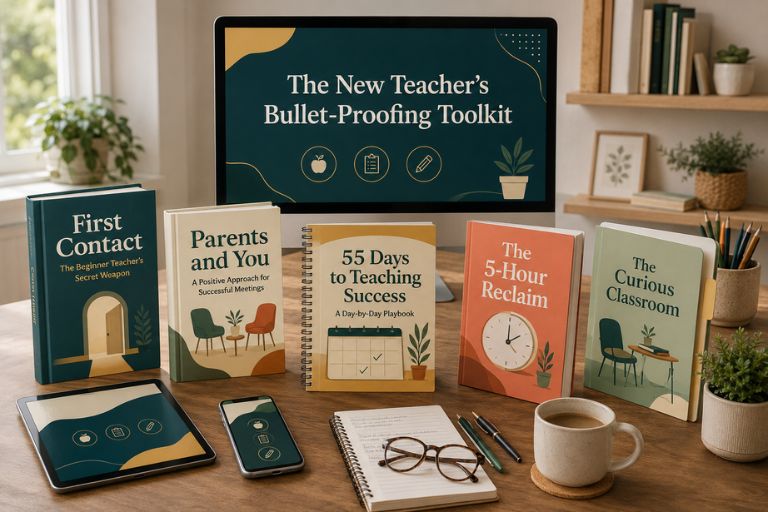
    NB: I just realised that the name “Bullet-Proofing Toolkit” might be inappropriate in a world where schools are plagued by shootings and gun violence. Accept my apology if this offended you. I will actually change the name if you comment below.

    For Parents and Learners:

  • The Steel Beneath the Silk

    Why Fortitude is the Ultimate Human Anchor

    There is a quiet, almost invisible quality that separates those who merely survive the passing seasons from those who anchor themselves permanently against the storm. It is not flashiness, it is not raw talent, and it is certainly not loud. It is the steady, unblinking capacity to look at a harsh reality, accept its weight, and continue walking forward without losing your humanity.

    We call this fortitude.

    In a world that increasingly values the swift, the loud, and the temporary, fortitude is an old soul. It is the mental and emotional strength to endure pain, adversity, or danger with courage. Far removed from physical power or brute force, fortitude is a virtue of deep, internal resilience—an intricate weave of bravery and patience that allows a person to persist through prolonged hardships. It is the internal architecture that keeps our standards high, our promises kept, and our hearts open when everything around us invites us to break, surrender, or grow cold.

    The Three Anchors of the Mind

    To understand fortitude is to look at it not as an accident of birth, but as a deliberate composition of character. It does not appear by chance; it is built through daily, uncompromised choices. When we break it down into its core characteristics, we find three distinct pillars that support a truly remarkable life:

    1. Endurance (The Armor Against Time)

    Endurance is the ability to withstand ongoing difficulty or suffering without yielding. It is easy to be motivated for an hour, a day, or a week. But true progress is a marathon hidden inside a series of invisible, monotonous days. Endurance means keeping your routine intact when the excitement has burned off. It means showing up to do hard work precisely when no one is watching, when the applause is absent, and when the reward feels a lifetime away.

    2. Mental Toughness (The Calm in the Crisis)

    Mental toughness is the steady, resolute firmness of mind that prevents panic. When a crisis strikes—whether it is a financial setback, a personal loss, or a dream that shatters upon contact with reality—the natural human instinct is to scatter or despair. Mental toughness is the quiet pause before the reaction. It is the internal command that dictates: Assess what can be controlled, disregard what cannot, and remain professional. It is the refusal to let outside chaos dictate your internal peace.

    3. Courage (The Choice of the Narrow Path)

    Courage within fortitude is rarely about battlefield heroics; it is the bravery needed to face fear, exhaustion, or temptation head-on. It is the courage to be reliable when being flaky is easier. It is the courage to remain polite, punctual, and respectful when the world around you has descended into cynicism and laziness.

    Where the Virtue Breathes: Historical Echoes

    We see the footprints of fortitude throughout history, left by individuals who understood that dignity is not something given by others, but something maintained within oneself.

    Consider the quiet dignity of those who built movements from nothing. When Ernest Shackleton’s ship, the Endurance, was crushed by Antarctic ice in 1915, leaving his crew stranded on ice floes for over a year, there was no room for panic. Shackleton did not rely on physical dominance; he relied on an unyielding professional routine. He kept his men strictly accountable to their daily duties, maintained structural order, and preserved their hope through absolute reliability. His fortitude ensured that despite unimaginable conditions, every single man under his care survived.

    We see it in the artistic world, too. When the legendary writer John Milton went completely blind at the age of 43, his greatest work was still unwritten. Rather than surrendering to despair or a life of dependency, he used his daughters and assistants to dictate his thoughts, line by line, creating Paradise Lost. That is fortitude in its purest form—the refusal to let physical limitations alter the trajectory of a purposeful mind.

    A Compass for the Lost and the Heavy-Hearted

    For anyone standing in the dark right now—for the student overwhelmed by the pressure of an uncertain future, for the young person who feels like hope is a luxury they cannot afford, or for those battling the heavy, gray weight of depression—fortitude is not a lecture. It is a lifeline.

    When you are deeply unhappy, the idea of “just being positive” can feel like an insult. Fortitude does not ask you to fake a smile or pretend things are perfect. In fact, it starts with total honesty: This hurts. This is hard. This is unfair.

    But right after that honesty, fortitude asks a beautiful, empowering question: What is the very next right move?

    You do not have to fix your entire life by tomorrow morning. You do not have to conquer the world by sunset. Fortitude is built in micro-moments of discipline:

    • It is choosing to clean your desk when your mind feels cluttered.
    • It is choosing to be on time for a small commitment, because keeping your word to others builds your trust in yourself.
    • It is executing a simple morning routine, because order creates a buffer against depression.

    When you choose discipline over despair, you are signaling to your own psyche that you are still the author of your story. You are demonstrating that while you cannot control the wind, you can absolutely control the set of your sails.

    The Ultimate Reward: Freedom and Respect

    The truly successful people in this world—the ones who enjoy an authentic life of freedom, independent wealth, and enduring respect—all share this silent ledger. They know that money can buy comfort, but it cannot buy character. Real independence belongs to the person who can lose everything tomorrow and still walk into a room with their head held high because their worth is entirely internal.

    When fortitude becomes part of your psychological makeup, you stop asking the world to be easy. Instead, you develop the skin to handle whatever it throws at you. You become a person who is relentlessly reliable, remarkably professional, and deeply independent.

    Let fortitude be your personal trademark. Wear it quietly. Let your punctuality speak for your respect; let your routine speak for your discipline; and let your endurance speak for your future. The road is long, and it will undoubtedly be steep at times, but there is a magnificent joy waiting for those who refuse to soften when the world gets hard. Stand firm, keep walking, and let the storm find out exactly what you are made of.

    Sources:

    https://www.merriam-webster.com/dictionary/fortitude

    https://www.youtube.com/watch?v=84h6gwTPfws&t=1

    https://www.etymonline.com/word/fortitude

  • My LinkedIn is Logged out and Pushed over

    As a part-time person on the internet, I am completely overwhelmed by LinkedIn and I am baffled by what it is for. It is incredible to me that people spend so much time there. Am I the only person that is losing my mind because of LinkedIn?

    I vividly remember a period about 10 or 15 years ago when I desperately tried to scrub my presence from LinkedIn. I had reached a point where I decided I simply would not be using it anymore, viewing it as more of a distraction than a tool. I spent hours navigating through convoluted settings menus and buried options just to unsubscribe and deactivate my profile.

    Honestly, I think it would be easier to physically jump off the earth without any rocket propulsion under you—just try to leap into orbit through sheer will! That is precisely how difficult and counter-intuitive it felt to escape the gravitational pull of LinkedIn’s retention tactics back then.

    Fast forward to today, and somehow, I find myself right back in the fold. I’m not even entirely sure why I let myself get sucked back in! I suspect I did this because I fell for that old, familiar promise once again: the allure of feeling “professional” and the perceived necessity of connecting with other high-achieving “professionals” in a dedicated digital space. It’s that same persistent marketing of career growth and networking that keeps pulling us back into the ecosystem, despite our better judgment.

    Okay – I wish you could hear my tone of voice right now – because it’s very sarcastic as I speak and I read this into Wispr Flow. I’m not connecting with anyone; I am creating spam for myself. It is driving me nuts.

    Can anybody please send me an email at info@lourensblog.com and tell me what on earth must I do to sort out this LinkedIn issue? I just asked four different AIs this question and it is absolutely loving LinkedIn. The videos on YouTube say that LinkedIn is now the most wonderful place. It’s the most searched place after Google and YouTube.

    It is just that everybody is lyrical about how wonderful LinkedIn is and I think LinkedIn sucks. I really do. What am I not getting?

    I do not understand it and I don’t know what I’m doing there. All these people who are following me and I’m following them and we are having to answer 17 types of LinkedIn emails all of a sudden in our inboxes.

    What is going on?

    Now, if I calm down, apply myself, and spend a few hours and really figure it out, am I going to be okay and will it have results? I really do not believe it at this point. Let me go and see …

    [ 2 hours later ]

    I just got verified and LinkedIn Premium. Looks great!

    By the way, here is my … um … you know … um … LinkedIn link:
    https://www.linkedin.com/in/lourensbreytenbach

    …

    Oh no … I did it again!

    Read all about how YOU can master the NEW LinkedIn

    I wrote a short ebook for you

    https://pages.lourensbreytenbach.com/linkedin

    LinkedIn article