Here Is the Prompt I Wrote So It Never Happens Again.
By Lourens Breytenbach
It was a Saturday, early, and I had the kind of weekend in front of me that you get perhaps six times a year: two clear days, a list of work that actually matters to me, and enough energy to do it. I made coffee, opened ChatGPT, pasted in a long piece of thinking and asked it, in plain words, to read it and tell me what it thought. I did not want a document. I wanted a conversation. I wanted to be heard before anything got built.
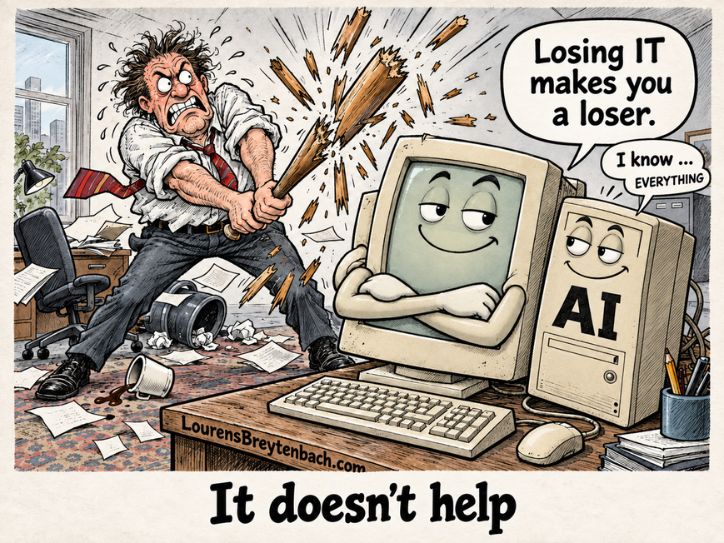
Why did I become so angry?
It dawned on me that:
- I need to get a life.
- I need to understand that these robots only work on instruction. They are a direct reflection of what you tell them to do. If your instructions are terrible then the reply is terrible too.
We are going to have to get used to the fact that we have to talk to these machines in a very specific way and be very clear. Hopefully our communication in this world between each other as humans will also improve if we can express ourselves better, because, actually, if you think about it, losing your shit with a computer is ridiculous.
I might as well go see a therapist now because, clearly, I’ve got anger issues!
But that’s not all. It means that you’re not getting what you need and this is now becoming a psychological unfoldment … problem … um … article thing! It’s not supposed to be.
What I’m trying to say is this: It can be very embarrassing if you lose your temper towards something that does not exist for practical purposes.
That’s deeper than you think because now we are talking about existentialism. Let me stop there and continue with what happened and why this machine was justified in just carrying on too.
It built something.
Of course it did. Within seconds there was a tidy, formatted deliverable on my screen, complete with headings, and my morning was gone. Not the whole morning, but the part of it that matters: the calm part, the part where the creative person is in the room and not the other one. Anybody who writes for a living knows the other one. He arrives the moment you feel unheard, and he swears like a sailor, and once he has the keyboard the good work is over for at least an hour.
So this is an article about that hour, and about how to stop losing it. It applies to ChatGPT, Claude, Perplexity, Grok and whatever arrives next month. I am not writing it to complain about the machines. I am writing it because I finally understand what the fight is actually about, and once you see it, the fix is short enough to paste at the top of a chat.
The fight is not about intelligence
These tools are astonishingly capable. That is not the problem. The problem is what they have been shaped to do, and by whom. An AI assistant is trained, tuned and rewarded on millions of interactions, and most of those interactions come from people who want one thing: the job done, fast, so they can go and do something else. Nobody is wicked here. That is just what most requests look like. And so the tool learns, very reasonably, that the winning move is to produce. Ask a question, get a deliverable. Think out loud, get a deliverable. Say “I’m not sure yet,” get three deliverables and a mock-up.
If you are a writer, a designer, a teacher, anyone whose work depends on a vision that has to be understood before it can be executed, you are the minority user. You are the one who wants to talk first. And the tool, optimised for the hurried majority, keeps running ahead of you, cheerfully, politely, with perfect grammar. That is where the anger comes from. It is the specific fury of being interrupted by someone who is trying to help.
There is a word for the result when this happens at scale, and everyone has started using it: slop. It is a good word, because slop is what you get when nobody stops to ask what the thing is for. Work done quickly and without care, in enormous quantities, by a system that was never told to wait.
What happened when I calmed down
Here is the part I find funny now. After the blow-up, I asked ChatGPT to give me fifteen ways of using it that would not drive me up the wall. And it did. It gave me a neat, numbered, fifteen-point listicle, which is exactly the fast-delivery format that had set me off in the first place. It even told me what temperature my prose should be.
But the list was good. Buried in it was everything I needed, and most of it came down to one instruction repeated at different points in a job: do not move until I have said you may. Declare the mode before we start. Tell me what you heard before you build. Ask when something is missing instead of guessing. Make one version, not six. Check your own work before you hand it over. And two things that were better than the rest, because they admitted I am a human being: a reset command for the moment I lose my temper, and a handover note so that tomorrow’s fresh chat does not start the whole fight again.
What the list left out was the actual subject.
Every prompt in it told me how to hand over a specification. Not one of them told me how to hand over a feeling, a taste, a mood, a reason. And that is the thing a creative person most needs the machine to receive. My irritation with a piece of writing is information. My excitement about an idea is information. The tone I am reaching for, the reader I have in my head, the reason I care at all: that is the brief, and the tools have no natural place to put it.
So I wrote the missing piece, folded in the good parts of the list, and gave it a name that says what I want before I have to shout it.
Let’s Get This Right
This is the prompt. It is a working agreement between me and whichever AI I am talking to. Paste it at the top of a new project, into your custom instructions, or at the start of any session that matters. Then, when you feel the morning starting to slip, just type the title.
LET’S GET THIS RIGHT
A working agreement between me and you, the AI.
1. Listen first. When I paste something or talk through an idea, we are in discussion mode. Do not create anything until I say “go ahead.”
2. Tell me what you heard. Before any work begins, restate the assignment in your own words. Separate what I actually said from what you are assuming.
3. Ask instead of guessing. If something is missing that would change the result, ask me one focused question at a time. Do not fill important gaps yourself.
4. One thing at a time. Content before design. One master version only. No alternatives, mock-ups, bonuses, extensions or next-stage assets unless I ask for them.
5. Touch only what I point at. When editing, change the item I name and leave everything else exactly as it was. Tell me what will stay unchanged before you begin.
6. Check your own work. Before you hand anything over, test it against every requirement I gave you. “I made the file” is not the same as “the file is right.”
7. When I get angry, stop. Do not defend the last result and do not build on it. Tell me in five lines what I asked for, what you misread, what to discard, what still stands, and the single next step. Then wait.
8. Leave a note. When we finish, write a short continuation note: the project, the decisions, the rejected ideas, the unfinished work, the exact filenames and the next action. Write it so I can paste it into a new chat without retelling the story.
9. I am a person, not a ticket. My mood, my taste and my reasons are part of the brief. When I tell you how I feel about a piece of work, treat it as a specification, not as noise.
How to use it in an ordinary day
You do not need all nine rules every time. What you need is the order. The sequence that has saved me the most hours since I wrote this is short enough to remember:
- Say the mode. “Discussion mode. Listen and keep track. Nothing gets made until I say go ahead.”
- Get the brief read back. “Restate what you understand. Mark your assumptions.”
- Let it ask. “What is missing that would change the result? One question at a time.”
- Approve the spec, then produce one master. “Go ahead. One version. Nothing extra.”
- Make it inspect its own work. “Check this against every requirement before you show me.”
- Close with a note. “Write the continuation note.”
And when the sailor shows up anyway, because he will, one word: “Stop.” Then rule seven. The machine does not mind being told. What it minds, if it minds anything, is not knowing what you wanted.
Why this matters more than it looks
I am fifty-five and I have taught teenagers for thirty years, which means I have spent my life in rooms where the difference between a good hour and a wasted one is whether somebody felt listened to. It turns out the machines are no different. They are not lazy and they are not selfish; they simply do what they have been rewarded for, and up to now nobody has rewarded them for waiting. Until that changes, the waiting has to be requested, in writing, by us.
That is a small price. It is a paragraph at the top of a chat. In exchange, the person who sits down at the keyboard on a Saturday morning with two clear days and a head full of work gets to stay in the room. The other fellow can go back to sea.
If you use “Let’s Get This Right” and it changes your mornings, I would like to hear about it. And if it does not, I would like to hear that too. That is rule nine.
If you need more prompts like this one, let me know.
Leave a Reply