Author: Lourens Breytenbach

  • Unmoted

    If you walked into my office right now and asked me what you should do to get that job or promotion, I would give you these five tips:

    The reason I can give you these tips is because I have been a teacher for 30 years. During the last 5, I was promoted twice.

    Click this image of a man who is standing in front of a mirror to view the Teacher's Bullet-Proofing Toolkit
    You are the they.

    1. Talk to People Face to Face

    You have to talk to managers and decision makers face to face. You don’t just send your CV in and you definitely do not just email it to the school. It will be buried and deleted.

    If you are lucky and it is printed at all, then you will find yourself at the bottom of a very high pile that’s aging and that gets recycled after a year or two.

    You need to walk into the principal’s office with your mooi-mooi’s on and you have to go and talk to her/him.

    Here’s what you must do:
    Go to the school/company’s office and convince the secretary or the receptionist that you just want to hand the principal your CV. You just want to shake his or her hand and introduce yourself so that they can see your face. You tell them that you are an English teacher (or whatever) or that you are applying for a position.

    Do it face to face, do it quickly, don’t hang around, don’t socialise, and make sure that you get out as soon as possible after giving the CV to the principal or the deputy principal if you can. They are very busy and they don’t want to have a long chat with you because they have 10 things to do and there’s only time for 4.

    2. Start Working on Sundays

    REALLY?

    Yes. The second thing I would do is start working on Sundays. Especially if you are aiming for a promotion at your current institution.

    First, it is still Sunday, so have a sleep-in, go to church if you can, and go and have lunch with Mom. Then … you take your bag, your books, and your laptop and go – to – school.

    As you sit there in your classroom or in your office (if you’re a HOD) calmly and purposefully sort out your “stuff” Monday.

    In other words, do your filing, throw away those scraps of paper that are all over the place, empty the inbox (the real one) that have been filling up… (usually it’s a sagging Typek box cover, isn’t it!) and get rid of all the clutter.

    • Make sure that your desk is neat and clean.
    • Get your diary up to date and know what to say on the Monday morning.
    • Know who’s going to open, know who’s going to do the talking, know what you want to get done early that week.
    • This will help you be prepared. It can be quite startling how much more confident you will feel. And you don’t have to fake it – you really are … actually … prepared!
    • This ensures that you don’t start the work week by being overwhelmed.

    TRUST ME: Someone who comes across as in shape on a Monday morning gets a lot of kudos from the managers.

    The reason is simple: It is because you don’t look as shocked by the Monday syndrome as others. The message is, “If he/she looks like that on a Monday, surely he/she can handle the pressure on any day!”

    Again: go to work on Sundays … and I’m not talking about marking or doing some kind of admin that can wait. I’m talking about getting yourself ready for the Monday by going to school on the Sunday afternoon. Spend 3 or 4 hours. I promise, it’ll make all the difference.

    3. Keep Work and Home Separate

    The third thing I would do is I would definitely stay after school and do my schoolwork at school and my “homework” at home. In other words don’t mix your work life with your home life. Homework in this context is living real life – spending time at your place, with your people. Your pets, your TV.

    The couch misses you! Don’t neglect it.

    I think there should be clear boundaries. When you are at work you are all dressed up and you are busy working. Just work at work. Don’t fu*k around on Facebook!

    But, when the day is over – it will be so good for you if you can – dust off your shoes … get into the car … go home and, if you’re lucky enough to have a family and children or someone that is waiting for you, be with those people and go and be there with them.

    4. Learn the Technology at the School

    The fourth thing I would do is I would learn the technology at the school. In other words if there’s an a SA SAMS-like system and you are not familiar with how to print a report, you can’t expect to get promoted.

    You have to know how to go into that LTSM module 14 and sort it out because the principal is going to ask you to do the textbooks next year.

    You have to know how to send a message on D6. If you’re using The System, you can’t ask the secretary or the lady in the office, as they say, or the tech support dude, to send a letter out to parents. You shouldn’t be struggling to get into the discipline system.

    When it comes to dealing with technology, using technology, reading messages and answering your emails and your WhatsApps, please make sure that your notifications are off. Make sure that you are not busy with little messages and emails all day long and that you actually can get onto the corridors and go and do some real help by getting the kids into classes.

    Go and talk to people in the corridors, get them to move along. Talk to the learners – especially the student leaders, and then, when you go back to your office or your classroom, you focus on the work. It’s all about focus, maximizing your time, maximizing effort, and prioritizing.

    5. Make Your Application Complete

    And lastly, when it comes to the interview or starting the process, make sure that your application is complete. Make sure that you fill in, in your own handwriting where possible, the complete list of your skills and abilities.

    Go on to another page and fill in four or five pages with everything significant that you can do. Do not forget to list your computer skills or your personal achievements and sell yourself actively.

    Be an agent for yourself.

    You need to be able to present your case. The principal and the governing body of that school are going to spend no more than 1 minute each on that CV of yours, if that much, maybe even less. It needs to be complete.

    The people at the district office are going to look at the CV and they’re going to scrutinize it, and your qualifications must be there.

    • There must be a decent cover letter.
    • You must have your details on the first page.
    • Don’t make them look for what you can teach.
    • Tell them on the first page what you teach and what your experience is.
    • What they want to know is: Is this guy a matric teacher? Can I use him? Is he going to be able to take that difficult Grade 8 group?
    • Is this woman going to be able to take the netball team that we’re struggling with or can she develop the cricket for the girls and things like that?

    Don’t be tentative when it comes to putting your CV together.

    6. Be Friendly and Enjoy the Process

    And here’s a sixth bonus tip for you. When you are in the process, be friendly and be kind, make a joke, enjoy your day, be a little bit entertaining, and don’t be so serious and afraid.It puts people off if you come accross as afraid. Be scared; don’t show it!

    Think of yourself as an adventurer on a trip, someone who’s busy with a trip.

    If you’re going to go see the Eiffel Tower, get up, dress up, go to the actual structure, and enjoy being there. Don’t be complaining about the weather on your way there and don’t be negative when you are standing in line.

    You are seeing the Eiffel Tower!

    You are standing there and you’re going to go up the lift and you are excited. Let the adrenaline pump and enjoy it. Let your promotion journey be like that.

    Now is not a good time to come across as traumatized and someone who is struggling to deal with a little bit of cortisol and adrenaline.

    You will never make it in this job or after actually getting that promotion if you can’t handle the interview.

    Enjoy it, have fun. You’re going to get paid a little bit more. You’re going to get a little bit more responsibility. Be worth it.

    7. Accept That You’ll Have Fewer Friends

    The very last thing I’d say is this: If you want to make it and get promoted, accept the fact that you’re going to have fewer friends.

    Accept that you will have people turn on you, that they will be gossiping about you, and that you will lose your friends that you used to spend time with in the smoking area.

    But it’s okay. They were never great friends to start with. Get some new friends. It’s not easy, but it is time you lifted that game too. That is one of my challenges now. So the journey continues.

    To learn more about how you can get ahead in teaching as a profession, get The Teacher’s Bullet-Proofing Toolkit.
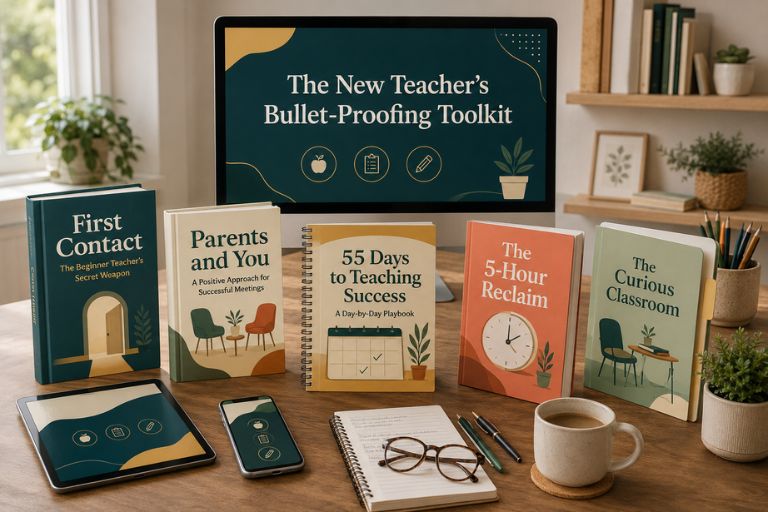
    NB: I just realised that the name “Bullet-Proofing Toolkit” might be inappropriate in a world where schools are plagued by shootings and gun violence. Accept my apology if this offended you. I will actually change the name if you comment below.
    For Parents and Learners:

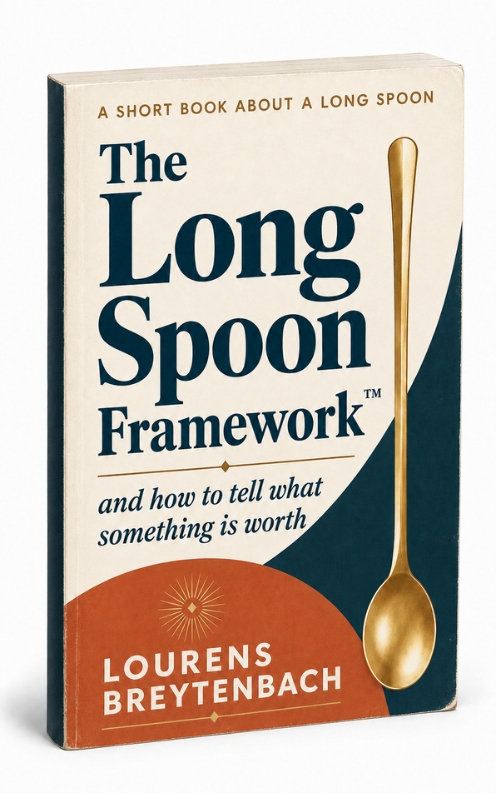
  • The Long Spoon Framework™

    A short book about a long spon

    by Lourens Breytenbach:

    The “Long Spoon Framework” is a thinking tool and philosophy created by Lourens Breytenbach to evaluate the true worth and functionality of people, products, ideas, and decisions.

    The Inspiration:
    Rooted in an appreciation for an extended stainless steel teaspoon that efficiently reaches deep jars without burning knuckles, the framework uses this object as a metaphor for utility, simplicity, and practical impact.

    The Three Spoons:

    Every environment contains three types of entities:

    The Short Spoon: Represents individuals or tools that cannot reach deep enough, resent demands, do the bare minimum with complaints, and blame their environment.

    The Swiss Champ: Represents overly complicated, expensive, or feature-heavy items (like a complex multi-tool or an over-engineered course) that look impressive on paper but are rarely used or practical.

    The Long Spoon: Represents effective entities that feature a single extended gift, are used daily, reduce difficulty, and leave a noticeable void when absent.

    The Five Checks & The Master Question

    The framework relies on a binary (yes/no) evaluation using five core checks, anchored by one superior master question:

    Belong: Does it fit naturally into the existing environment without requiring a complete reorganization?

    Stand Out: Does it possess a distinct, useful quality rather than mere decoration?

    Reach: Can it solve problems or access areas that ordinary versions cannot, returning clean?

    Protect: Does its involvement reduce mess, risk, difficulty, and harm?
    Endure: Is it strong, reliable, and durable over time (such as across ten years)?

    The Master Question (Would it be missed?): This outranks all other checks. Even if a thing passes all five checks, if its absence goes unnoticed, it lacks true long-spoon value.

    Evaluation Rules
    Scoring outcomes: 5 yeses indicate a true long spoon; 1 no indicates a fixable area where a specific handle should be lengthened; 2 or more noes mean it is not a long spoon yet.

    Mandatory Rules:
    The tester must run the evaluation on themselves first (the reader is case study one). The test can only be applied to someone if the evaluator is prepared to make them coffee first (establishing direct connection and cost).

    Try the SPOONtaneity Scorer App

    Buy the Book

    Cutlery Academy

  • I Lost My Temper With ChatGPT This Morning.

    Here Is the Prompt I Wrote So It Never Happens Again.

    By Lourens Breytenbach

    It was a Saturday, early, and I had the kind of weekend in front of me that you get perhaps six times a year: two clear days, a list of work that actually matters to me, and enough energy to do it. I made coffee, opened ChatGPT, pasted in a long piece of thinking and asked it, in plain words, to read it and tell me what it thought. I did not want a document. I wanted a conversation. I wanted to be heard before anything got built.

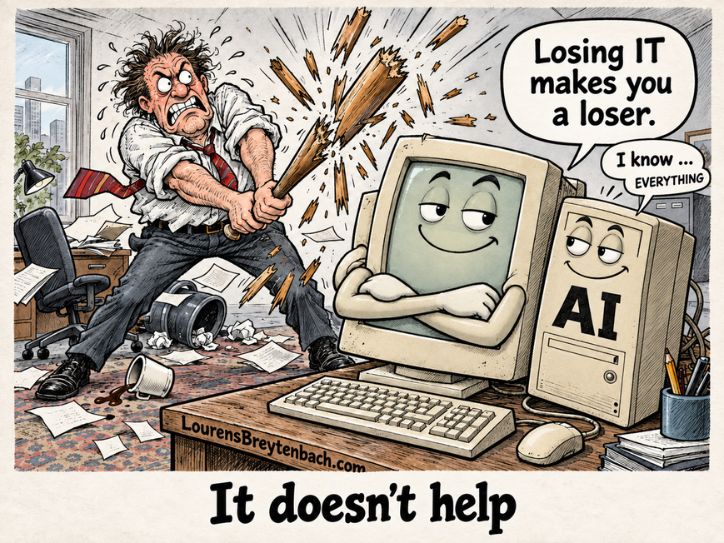
    Man losing his temper with AI, but the AI PC and box is not phased at all.

    Why did I become so angry?

    It dawned on me that:

    1. I need to get a life.
    2. I need to understand that these robots only work on instruction. They are a direct reflection of what you tell them to do. If your instructions are terrible then the reply is terrible too.

    We are going to have to get used to the fact that we have to talk to these machines in a very specific way and be very clear. Hopefully our communication in this world between each other as humans will also improve if we can express ourselves better, because, actually, if you think about it, losing your shit with a computer is ridiculous.

    I might as well go see a therapist now because, clearly, I’ve got anger issues!

    But that’s not all. It means that you’re not getting what you need and this is now becoming a psychological unfoldment … problem … um … article thing! It’s not supposed to be.

    What I’m trying to say is this: It can be very embarrassing if you lose your temper towards something that does not exist for practical purposes.

    That’s deeper than you think because now we are talking about existentialism. Let me stop there and continue with what happened and why this machine was justified in just carrying on too.

    It built something.

    Of course it did. Within seconds there was a tidy, formatted deliverable on my screen, complete with headings, and my morning was gone. Not the whole morning, but the part of it that matters: the calm part, the part where the creative person is in the room and not the other one. Anybody who writes for a living knows the other one. He arrives the moment you feel unheard, and he swears like a sailor, and once he has the keyboard the good work is over for at least an hour.

    So this is an article about that hour, and about how to stop losing it. It applies to ChatGPT, Claude, Perplexity, Grok and whatever arrives next month. I am not writing it to complain about the machines. I am writing it because I finally understand what the fight is actually about, and once you see it, the fix is short enough to paste at the top of a chat.

    The fight is not about intelligence

    These tools are astonishingly capable. That is not the problem. The problem is what they have been shaped to do, and by whom. An AI assistant is trained, tuned and rewarded on millions of interactions, and most of those interactions come from people who want one thing: the job done, fast, so they can go and do something else. Nobody is wicked here. That is just what most requests look like. And so the tool learns, very reasonably, that the winning move is to produce. Ask a question, get a deliverable. Think out loud, get a deliverable. Say “I’m not sure yet,” get three deliverables and a mock-up.

    If you are a writer, a designer, a teacher, anyone whose work depends on a vision that has to be understood before it can be executed, you are the minority user. You are the one who wants to talk first. And the tool, optimised for the hurried majority, keeps running ahead of you, cheerfully, politely, with perfect grammar. That is where the anger comes from. It is the specific fury of being interrupted by someone who is trying to help.

    There is a word for the result when this happens at scale, and everyone has started using it: slop. It is a good word, because slop is what you get when nobody stops to ask what the thing is for. Work done quickly and without care, in enormous quantities, by a system that was never told to wait.

    What happened when I calmed down

    Here is the part I find funny now. After the blow-up, I asked ChatGPT to give me fifteen ways of using it that would not drive me up the wall. And it did. It gave me a neat, numbered, fifteen-point listicle, which is exactly the fast-delivery format that had set me off in the first place. It even told me what temperature my prose should be.

    But the list was good. Buried in it was everything I needed, and most of it came down to one instruction repeated at different points in a job: do not move until I have said you may. Declare the mode before we start. Tell me what you heard before you build. Ask when something is missing instead of guessing. Make one version, not six. Check your own work before you hand it over. And two things that were better than the rest, because they admitted I am a human being: a reset command for the moment I lose my temper, and a handover note so that tomorrow’s fresh chat does not start the whole fight again.

    What the list left out was the actual subject.

    Every prompt in it told me how to hand over a specification. Not one of them told me how to hand over a feeling, a taste, a mood, a reason. And that is the thing a creative person most needs the machine to receive. My irritation with a piece of writing is information. My excitement about an idea is information. The tone I am reaching for, the reader I have in my head, the reason I care at all: that is the brief, and the tools have no natural place to put it.

    So I wrote the missing piece, folded in the good parts of the list, and gave it a name that says what I want before I have to shout it.

    Let’s Get This Right

    This is the prompt. It is a working agreement between me and whichever AI I am talking to. Paste it at the top of a new project, into your custom instructions, or at the start of any session that matters. Then, when you feel the morning starting to slip, just type the title.

    LET’S GET THIS RIGHT
    A working agreement between me and you, the AI.

    1. Listen first. When I paste something or talk through an idea, we are in discussion mode. Do not create anything until I say “go ahead.”

    2. Tell me what you heard. Before any work begins, restate the assignment in your own words. Separate what I actually said from what you are assuming.

    3. Ask instead of guessing. If something is missing that would change the result, ask me one focused question at a time. Do not fill important gaps yourself.

    4. One thing at a time. Content before design. One master version only. No alternatives, mock-ups, bonuses, extensions or next-stage assets unless I ask for them.

    5. Touch only what I point at. When editing, change the item I name and leave everything else exactly as it was. Tell me what will stay unchanged before you begin.

    6. Check your own work. Before you hand anything over, test it against every requirement I gave you. “I made the file” is not the same as “the file is right.”

    7. When I get angry, stop. Do not defend the last result and do not build on it. Tell me in five lines what I asked for, what you misread, what to discard, what still stands, and the single next step. Then wait.

    8. Leave a note. When we finish, write a short continuation note: the project, the decisions, the rejected ideas, the unfinished work, the exact filenames and the next action. Write it so I can paste it into a new chat without retelling the story.

    9. I am a person, not a ticket. My mood, my taste and my reasons are part of the brief. When I tell you how I feel about a piece of work, treat it as a specification, not as noise.

    How to use it in an ordinary day

    You do not need all nine rules every time. What you need is the order. The sequence that has saved me the most hours since I wrote this is short enough to remember:

    1. Say the mode. “Discussion mode. Listen and keep track. Nothing gets made until I say go ahead.”
    2. Get the brief read back. “Restate what you understand. Mark your assumptions.”
    3. Let it ask. “What is missing that would change the result? One question at a time.”
    4. Approve the spec, then produce one master. “Go ahead. One version. Nothing extra.”
    5. Make it inspect its own work. “Check this against every requirement before you show me.”
    6. Close with a note. “Write the continuation note.”

    And when the sailor shows up anyway, because he will, one word: “Stop.” Then rule seven. The machine does not mind being told. What it minds, if it minds anything, is not knowing what you wanted.

    Why this matters more than it looks

    I am fifty-five and I have taught teenagers for thirty years, which means I have spent my life in rooms where the difference between a good hour and a wasted one is whether somebody felt listened to. It turns out the machines are no different. They are not lazy and they are not selfish; they simply do what they have been rewarded for, and up to now nobody has rewarded them for waiting. Until that changes, the waiting has to be requested, in writing, by us.

    That is a small price. It is a paragraph at the top of a chat. In exchange, the person who sits down at the keyboard on a Saturday morning with two clear days and a head full of work gets to stay in the room. The other fellow can go back to sea.

    If you use “Let’s Get This Right” and it changes your mornings, I would like to hear about it. And if it does not, I would like to hear that too. That is rule nine.

    If you need more prompts like this one, let me know.

    Watch the video

    www.lourensbreytenbach.com

  • Why Most Study Habits Fail

    What a Good Study Framework Requires

    Most students do not have a learning problem. They have an process problem. I have watched this for thirty years.

    Every exam season, good kids sit down at a desk, open a thick textbook, pull out a highlighter, and start painting paragraphs yellow. They reread the same chapter for hours. They copy sentences into a neat notebook. They walk away feeling as if they have done the work.

    Then exam day arrives and the page goes blank.

    That is not laziness. It is not a lack of intelligence. It is the fluency illusion. Recognising a sentence while it is sitting in front of you is a completely different job from pulling that idea out of memory when the paper is empty and the clock is running. Most of the study habits we still treat as “hard work” never ask the brain to do the second job. They just make the first one feel familiar.

    A poor study setup almost never fails because the student is not clever enough. It fails because the system itself works against how memory actually forms.

    What a broken system does

    1. It counts hours in the chair instead of what you can retrieve without looking.
    2. It defaults to busywork that feels productive — highlighting, rereading, rewriting notes — and builds almost no lasting pathway.
    3. It leaves the phone within reach and the task vague: “study biology tonight.”
    4. And when the rigid timetable inevitably breaks, it turns the miss into a character flaw instead of a design problem.

    What it never does

    • It never diagnoses the real bottleneck. Was it exhaustion? A task that was too vague to start? The phone? A method that never asked you to retrieve?
    • It treats the brain like a bucket to fill, not a muscle that only strengthens when you pull information out.
    • It ignores the forgetting curve and bets everything on one long cram.
    • It has no plan for a low-energy evening, a late practice, or a day that simply did not go as drawn.

    What actually works looks quieter than that

    Every stretch of input needs a stretch of output. That is the whole shift.

    What most of us were taughtWhat holds under pressure
    Highlighting and rereadingActive recall. Blank page. Say it or write it without looking
    Four-hour marathonsShort, spaced loops. Fifteen to twenty minutes, then stop
    “Review Chapter 4”“Solve five problems with the book closed”
    Phone on the deskA launch ritual and a real attention zone
    Guessing why the mark droppedFinding the specific leak and fixing that one thing

    I did not invent any of this. Cognitive science has been clear for years. I just spent long enough in classrooms, parent meetings, and exam halls to get tired of watching the same collapse. So I built a system that takes those principles and makes them usable on a Tuesday night when energy is low and the phone is loud.

    That is The Smart Study System.

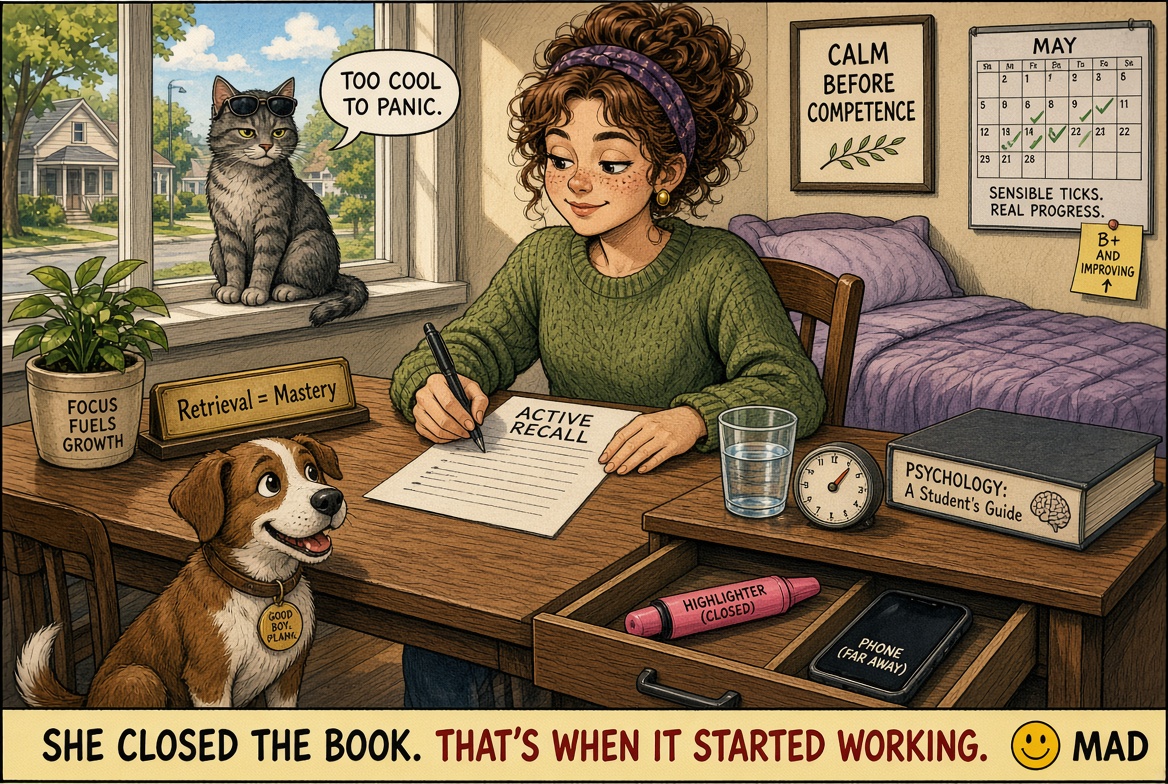
    Illustrated study scene: a girl practices active recall at her desk with a dog nearby, a cat saying "Too cool to panic," and motivational signs. Caption: "She closed the book. That's when it started working

    It does not ask you to become a different person. It gives you a few practical pieces that work together:

    • Simple diagnostics that show whether the leak is energy, clarity, attention, or method — so you stop fixing the wrong thing.
    • Printable worksheets and trackers that take the friction out of planning and hold the edges of the week.
    • Short video explanations that skip the academic fog and show you how retrieval, spacing, and mapping actually look at a desk.
    • Memory tools you can use the same evening: retrieval practice, spaced recall, concept maps that replace the highlighter.

    The aim is modest and optimistic at the same time. Spend less time at the desk. Keep far more of what you studied.

    You do not need six free hours every night to turn this around. The useful work happens in blocks of fifteen to twenty minutes, if the block is built correctly.

    If your current routine feels heavy, exhausting, or strangely ineffective, you do not need more willpower.

    You need a reset.

    You can start at www.smartstudysystem.com. The free starter tier is generous on purpose. I want you to feel the mechanics work before you decide anything further.

    I still work directly with learners, and I keep that circle small so the guidance stays real. If you want a place on that list, go across and put your name down. No drama. Just a better architecture for the work you are already willing to do.

    The Smart Study System is my new passion – it is becoming my life’s work. Check it out today and give me your feedback at info@lourensbreytenbach.com

    Go and try the FREE diagnostig check-up. It’s quite fun to do on the app. There are no wrong answers!

    Study Leak Diagnostic — free study tool by Lourens Breytenbach at SmartStudySystem.com. Find what is stopping your grades from rising

    See you inside the app!

    The Smart Study System – your new way to learn.

  • Is a “Study Leak” Draining Your Grades?

    Put fixing the “study leak” on a different list than the bucket list. You don’t want THAT bucket to start leaking at age 13!

    Ever feel like you are studying for hours but have absolutely nothing to show for it? You sit at your desk, open your textbooks, and put in the time. Yet, when test day arrives, your marks simply do not reflect your effort. You aren’t lacking intelligence, and you aren’t necessarily lazy. Instead, you are likely suffering from a study leak.

    A study leak is a hidden habit, environmental cue, or subtle distraction that causes your focus and retention to bleed away without you even noticing. It is the academic equivalent of a tiny puncture in a water bucket; even if you keep pouring in effort, the results slowly drain away.

    To fix your grades, you first need to identify where the energy is escaping.

    Here are seven common study leaks that quietly ruin your academic performance:

    1. Notification Blame: Blaming a chemistry topic for being “too hard” when the real culprit is your phone screen lighting up next to you.
    2. The Quick Check: Opening a browser tab to look up a quick fact, only to “leak” 20 minutes into social media notifications.
    3. Passive Reviewing: Spending hours re-reading notes or highlighting text instead of actively testing your brain.
    4. Productive Procrastination: Organizing your desk, cleaning your room, or making aesthetic timetables instead of actually studying.
    5. The Audio Trap: Listening to lyrical music or podcasts in the background, which fills up your working memory.
    6. Tab Hopping: Keeping twenty unrelated browser tabs open while writing an essay, fragmenting your attention span.
    7. Brain Drain: Attempting to cram complex concepts late at night while sleep-deprived, ensuring zero long-term retention.

    When these leaks happen simultaneously, your productivity drops to zero. You feel exhausted, yet your academic progress stalls completely.

    Find Your Personal Leak Today

    The trickiest part about a study leak is that it is often completely invisible to the person doing it. You might honestly believe you studied for four hours, unaware that leaks drained two hours of that time away.

    Are you ready to plug the holes in your routine and finally get ahead academically? Head over to www.studyleakfix.com right now. You can take our cool, quick diagnostic test designed specifically for learners who are struggling to reach their full potential. Stop wasting your hard work and discover exactly how to fix your focus today!

    Feeling overwhelmed makes your brain freeze, which naturally leads to procrastination. When you are stuck at home in this loop, you need to break the paralysis with physical actions rather than mental willpower.

    Here are 5 immediate steps a learner can take to break the cycle and regain control:

    1. Execute a 5-Minute “Brain Dump”

    When you are overwhelmed, your working memory is overcrowded with tasks, deadlines, and anxiety. Grab a piece of scrap paper and write down absolutely everything stressing you out. Do not organise it or make it look neat. Getting the chaos out of your head and onto paper immediately lowers your cortisol levels and reduces mental paralysis.

    2. Shrink the Task to a “Micro-Step”

    Procrastination happens because a task feels too large to start. Scale your expectation down to something ridiculously small. Do not tell yourself, “I need to study Chapter 4.” Instead, say, “I am going to open the textbook to page 50 and read exactly one sub-heading.” Once you cross the friction barrier of starting, momentum usually takes over.

    3. Change Your Physical Environment

    Your brain associates your current desk, chair, or bed with the feeling of stress and procrastination. Break this environmental anchor. Move to the dining room table, sit on the floor in a different room, or simply step outside for three minutes to breathe fresh air. A physical reset tricks your brain into a fresh cognitive start.

    4. Use the “Inverse Pomodoro” Rule

    If a standard 25-minute study block feels impossible, flip the stakes. Commit to studying for just 5 minutes, followed by a 5-minute break. Tell yourself you are allowed to quit after those 5 minutes if you want to. Because starting is the hardest part of procrastination, you will find that once the 5-minute timer goes off, you actually want to keep going.

    5. Put Your Phone in Another Room

    Do not rely on willpower to ignore your phone; when you are overwhelmed, your willpower is at its lowest. Physically remove the temptation. Put your phone on silent and leave it in another room or inside a drawer downstairs. Out of sight genuinely means out of mind, instantly plugging the primary “study leak” that feeds procrastination.

    Identify your learning challenges with the Study Leak Diagnostic Quiz

  • How to learn how to learn how to learn …

    Learning how to learn is one of the most useful skills you can build in high school. It changes how much you get done, how confident you feel in tests, and how much free time you actually have left for the rest of your life. Most students never get taught this properly. They just keep pushing harder with the same weak methods and wonder why everything takes so long.

    Here is a clear way to think about it.

    The Myths That Hold Most Students Back

    Three common beliefs stop progress before it starts.

    The first is the idea that you simply don’t have enough time or that you’re “not smart enough.” Almost every overloaded student feels this. The real problem is almost never a shortage of hours or IQ points. It is that the hours you do have are spent relearning things you keep forgetting. Small improvements in how you process and hold information — even 20 or 30 percent — free up whole evenings and weekends. Everyone can get noticeably better. The ceiling is not fixed.

    The second myth is learning styles. The claim that you are a “visual learner” or an “auditory learner” and should stick only to that way is not supported by strong evidence. Preferences exist. Most people process pictures faster than pure text, and many of us grew up with heavy reading-and-writing habits. Those are starting points, not limits. Relying on only one mode becomes a weakness the moment information arrives in a different form — a teacher explaining something, a group discussion, a practical task. Mixed approaches work better for almost everyone. Comfortable habits are useful only if you keep expanding them.

    The third myth is that good learning should feel easy. Effective learning requires mental effort. When a method makes you think harder, feel a bit confused, and work through that confusion, many students interpret the discomfort as proof the method is failing. They drop it and return to easier techniques that feel better but produce weaker results. The discomfort is often a sign that your brain is doing the deeper work that actually sticks. Learning does not need to feel easy. It needs to be effective. The price is focused mental effort in the time you already spend, not simply more hours.

    Learning as a System: Encoding and Retrieval

    Think of learning as a system with two main parts.

    Encoding is what happens when new information first enters your brain. Your brain decides what is worth keeping by asking how the new piece connects to what you already know, why it matters, and where it fits. Strong encoding turns isolated facts into connected, sticky knowledge. Weak encoding leaves information floating and easy to forget. The skill is learning how to make new material feel relevant and linked even when it does not arrive that way.

    Retrieval is pulling knowledge back out and using it — explaining it, solving a problem, answering a question, or applying it. Retrieval is necessary because knowledge only becomes useful when you can access it. It also strengthens the memory itself. Every time you retrieve something properly, you re-encode it and slow down how quickly it fades.

    Poor encoding produces shallow understanding and fast forgetting. Poor retrieval leaves gaps undetected and fluency slow. The practical order for most students is to get retrieval solid first. Retrieval skills improve quickly and give immediate results. Encoding habits take longer to rewire. Raise the quality and frequency of retrieval until your performance reaches the level you need, then improve encoding so you need less constant reviewing later.

    Knowledge fades according to a predictable curve. If you leave new material untouched, most of it disappears within days. Testing yourself after a short gap, then again after a longer gap, and adjusting the timing based on how much you still remember, keeps the material topped up and slows future fading. Better initial encoding makes the curve flatter from the start, so you need fewer reviews overall.

    When practising retrieval, three rules matter. Make it generative — produce something with the knowledge rather than just reread or rethink it. Make it require manipulation — combine ideas, apply them, or relate them instead of simple recall. Do as much as possible from free recall with minimal prompts. These practices surface gaps early, while there is still time to fix them.

    Busy students do not always need separate study sessions for retrieval. Look for chances inside existing work: explaining a concept to a classmate, writing a short summary from memory before checking notes, or preparing for a discussion without looking everything up first. Turn ordinary tasks into retrieval opportunities whenever possible.

    Orders of Learning: Isolated Facts vs Connected Thinking

    Not all learning is the same depth.

    Lower-order learning treats information in isolation — single facts, single definitions, single concepts. Higher-order learning treats information as connected. You ask how one idea affects another, which factors matter more, how changing one piece changes the rest, and how to use the knowledge to make decisions or solve problems.

    Higher-order thinking forces information into networks. Memory is stronger inside networks. That is why students who regularly practise relating, prioritising, and applying material forget less and understand more deeply.

    Most school habits push lower-order work. The real difficulty is not that higher-order thinking is impossible. Most students can do it. The difficulty is overriding the habit of trying to pin down every isolated piece before moving on. It feels uncertain at first to leave some details incomplete while you focus on connections. That discomfort is normal. Staying with the process of grouping, relating, and simplifying is what builds both stronger memory and deeper understanding.

    When you first meet new material, deliberately look for relationships. When you later test yourself, choose methods that force those same relationships — explaining the topic simply, mapping how the pieces influence one another, or working through a problem that requires several ideas at once.

    Self-Management: Getting Yourself to Do the Work

    Even strong learning methods fail if you cannot sit down and stay focused. Three practical areas matter: time, tasks, and attention.

    Time management is straightforward. Use a calendar and block the hours you intend to study, rest, and do other necessary things. Track how long tasks actually take so your plan matches reality. Plan slightly less than you think you can handle. Under-scheduling that you complete is far better than ambitious schedules that constantly collapse.

    Task management is where most students lose the most ground. The feeling of “too much to do and never enough time” is usually a prioritisation problem. Collect every task in one place. Then sort ruthlessly. Protect time for important work that is not yet urgent — the skills, habits, and preparation that will make future weeks easier. Do the truly urgent and important work next. Batch or simplify low-importance urgent tasks. Delete or ignore the rest. Many things that feel pressing have consequences you can actually live with. Raising your threshold for what counts as important frees surprising amounts of capacity. Living only in the urgent zone keeps the urgent zone permanently full.

    Attention is the final piece. Short-term tools such as website blockers or simple accountability arrangements with a friend can help immediately. Treat them as temporary supports. The longer-term skills that actually change capacity are three mental habits:

    • Getting comfortable with boredom. Constantly escaping quiet moments trains the brain to seek distraction. Practising sitting with nothing for short periods reduces that restlessness and also gives the brain space to consolidate what it has been learning.
    • Getting better at starting hard work. The heaviest resistance is usually at the beginning. Lower the bar to simply setting up — opening the materials, writing the first heading, gathering what you need. Once something is started, continuing becomes easier. Over time the avoidance impulse stays, but the trained response of beginning overrides it more often.
    • Getting better at returning attention. Notice when your mind has drifted and bring it back. Simple practice — focusing on one ordinary activity and returning whenever attention wanders — builds this control. The skill transfers directly to study sessions.

    These three habits take weeks and months of light, consistent practice. They produce far more lasting improvement than any single productivity trick.

    Putting It Together

    When you stop believing the common myths, treat learning as a system of encoding and retrieval, aim for connected rather than isolated thinking, and manage time, tasks, and attention with realistic habits, the results compound. Memory improves. Understanding deepens. The same hours produce more progress. Free time increases instead of disappearing.

    None of this is complicated in theory. The hard part is consistent practice and willingness to feel the temporary discomfort of better methods. Start with retrieval quality and frequency, protect time for higher-order thinking, and keep the self-management basics simple and honest. The rest follows.

    Visit SmartStudySystem.com to learn more

  • WHY WE STILL STUDY SHAKESPEARE

    Four hundred years on, the numbers say he’s still the biggest name in the business.

    (Written for my matrics of 2026) Not sure they ever read it. I hope you will. It is about a very important play. One of Planet Earth’s biggest assets, and written by an enlightened man who changed this same world by being.

    Here is a strange fact to start with: the writer your syllabus keeps forcing on you is, by most estimates, the best-selling author in human history. Around four billion copies of Shakespeare’s works have been sold — a number that puts him ahead of every thriller writer, every fantasy series, every celebrity memoir ever printed.

    Not bad for a man who has been dead for over four hundred years and never once went on a book tour. And he isn’t sitting quietly on a shelf, either. Shakespeare holds the Guinness World Record as the most-filmed author of all time, with more than four hundred film and television adaptations of his plays — and Hamlet alone has been filmed over fifty times.

    His work has been translated into more than a hundred languages, including, believe it or not, Klingon. Somewhere on Earth right now, it is a fairly safe bet that someone is performing one of his plays. Four centuries of continuous performance, and the run shows no sign of
    closing. You have also been quoting him your whole life without knowing it. If you have ever broken the ice, gone on a wild goose chase, waited with bated breath, been in a pickle, met someone with a heart of gold or watched something vanish into thin air — that’s all him.

    Scholars estimate his plays contain the first recorded use of roughly 1,700 English words. He didn’t just write in the language you speak; he helped build it. Hollywood certainly hasn’t stopped borrowing.

    The Lion King is Hamlet with lions — murdered king, guilty uncle, a prince who runs from his duty. West Side Story is Romeo and Juliet. 10 Things I Hate About You is The Taming of the Shrew wearing a high-school uniform. When modern writers need a story that works, they keep reaching for the same four-hundred-year-old blueprints, because nobody has drawn better ones.

    There is a South African chapter to this story too. On Robben Island, a copy of Shakespeare’s complete works was secretly passed among the political prisoners, disguised behind Diwali greeting cards. Dozens of them signed their names beside the lines that meant the most to them.

    Nelson Mandela chose a passage from Julius Caesar: “Cowards die many times before their deaths; the valiant never taste of death but once.” Men facing life sentences found their own courage written down by a playwright from another century, on another continent.

    That book is now called the Robben Island Bible. And that, in the end, is the real answer. We don’t study Shakespeare because he is old; plenty
    of old writing is forgotten. We study him because he understood people — jealousy, ambition, grief, first love, the fear of making the wrong choice — better than almost anyone before or since, and people haven’t changed.

    In 2020, a single copy of his First Folio sold for nearly ten million dollars. But the ideas inside it? Those are sitting in your setwork, free. Four billion readers already took the deal.

    It might be worth finding out why.

    You can download a 20-page booklet about Hamlet for FREE from my website: https://pages.lourensbreytenbach.com/english

    Good night Sweet Princes and Princesses!

  • The Smooth Ride to Success

    Why Doing Your Homework – Like a New Job – Changes Everything

    Imagine you land the job you’ve been hoping for. The salary is fair. The work is meaningful. You show up on day one grateful — not because every task is exciting, but because you understand what the work is buying you. You don’t complain about the emails or the reports. You don’t leave them piling up. You simply do them, cleanly and without drama, because that is how professionals operate. That quiet decision — to treat the work as the price of the life you want — is the same decision that separates learners who glide toward success from those who spend years fighting their own resistance.

    Homework is that work.

    Think of the kitchen sink. Leave the plates after supper and by morning you face a crusted, demoralising mountain. Wash them immediately and the task stays small, almost pleasant. The same principle applies to homework. When you sit down the same afternoon or evening and clear the day’s assignments while the material is still warm in your mind, the load never becomes overwhelming. The habit of finishing protects you from the far heavier tax of procrastination: the guilt, the late-night panic, the half-understood concepts that keep compounding.

    Now think of the gym.

    The first few weeks feel awkward and tiring. Your body resists. Then something shifts. The same session that once left you drained starts to feel manageable, even satisfying. Strength appears. Endurance appears. The mind that once negotiated with itself begins to move automatically toward the door. Research on habit formation shows there is no magic number of days, but the pattern is clear: consistent repetition turns effort into identity. Gym habits typically take months to lock in; simpler daily routines form faster. Homework works the same way. The learner who treats it as a non-negotiable daily appointment eventually discovers that the resistance fades and the capacity grows.

    A well-paid professional does not rely on inspiration. He relies on a disciplined mind and a reliable routine. He protects the hours, reduces friction, and shows up whether he feels like it or not. That same professional mindset is available to any learner who decides the smooth ride is worth more than the temporary comfort of avoidance.

    The evidence is not romantic, but it is consistent. Harris Cooper’s large-scale syntheses of decades of studies found that homework has a positive effect on achievement, and the effect grows stronger as students move into secondary school. High-school students who regularly complete homework tend to outperform a clear majority of peers who do not. More recent meta-analyses and international data continue to show that the frequency of meaningful practice matters more than sheer volume. When homework is purposeful rather than busywork, it strengthens retention, deepens understanding, and builds the non-academic muscles that matter most: self-direction, time management, and the capacity to work independently.

    These are not minor side benefits.

    They are the exact skills that later determine whether a young person can handle university deadlines, workplace projects, or the long, quiet work of building a life. The learner who practises sitting alone with a difficult problem and staying with it is practising the same discipline that will serve them when no teacher is watching and no grade is attached.

    Homework is not free of cost. Excessive loads, poorly designed tasks, and the pressure of constant deadlines can raise stress, steal sleep, and leave students feeling that school is an endless transaction rather than a place of growth. Research has repeatedly shown that beyond a sensible threshold the returns diminish and the emotional price rises. Elementary students gain far less from formal homework than older learners. Inequity can widen when some students have quiet space, support, and resources while others do not.

    A disciplined, easy, relaxing routine is the practical answer to most of these problems. The goal is never to over-work. The goal is to finish the assigned work in a calm, protected block of time so that the rest of the evening remains free for rest, family, sport, or genuine leisure. When the habit is established, the daily session becomes shorter and cleaner rather than longer and more frantic. The positive attitude is not forced cheerfulness; it is the quiet recognition that this work is the training ground, not the enemy.

    Independent and quiet study matters for a simple reason: the mind that can focus without constant external stimulation is the mind that can think. Complaining keeps the focus on resistance. A positive stance — “this is the work that buys me the future I want” — keeps the focus on the return.

    In the last few years a large study of more than 26 000 secondary students tracked what happens when generative AI is used to complete homework. Homework scores rose and completion times dropped. Closed-book exam scores, however, fell sharply — by around 20 percent within six months, with the full damage to high-stakes entrance exams appearing only after about two years. The students who outsourced the thinking performed well on the product and poorly on the understanding. Those who used AI as a limited tool while still doing the cognitive work themselves held their gains.

    AI can produce the finished page. It cannot produce the neural pathways, the pattern recognition, the frustration tolerance, or the quiet confidence that come from wrestling with a problem yourself. Calculators did not remove the need to understand mathematics; they shifted the focus. AI will do the same with homework. The assignments will change. The requirement for independent, disciplined mental work will not disappear. If anything, it will become more valuable, because the ability to think clearly when the tool is unavailable will separate those who merely look competent from those who actually are.

    Homework is here to stay

    Not as endless worksheets, but as the daily practice of showing up for your own mind. In the modern era the form will evolve. The underlying demand will remain: the willingness to sit down, work quietly, finish what is required, and do it without complaint because you understand the exchange.

    The learner who wants the smooth ride does not wait for motivation. He builds the routine the way a professional builds a career and the way a gym-goer builds a body — one ordinary, repeated decision at a time. Wash the dishes while they are still easy. Go to the gym even when it feels pointless. Treat the homework as the job you are grateful to have, because it is training you for the life you actually want.

    That is not hardship. That is the price of a clear road.

    If you are a parent, or a teacher, and you know “some youngsters” who struggle to commit to their schoolwork and studying – I have the perfect solution for you:

    The Complete Teen Study Reset

    To download my free ebook about reconnecting with your teen – follow THIS LINK

  • Why Your Homework is Like Yesterday’s Dirty Dishes

    A Guide to High-Performance Living

    1. The “Rotten Dishes” Analogy

    Imagine you just finished a big dinner. You have two choices: you can spend ten minutes rinsing the plates now, or you can leave them in the sink until tomorrow. If you leave them, the sauce dries into a cement-like crust, the smell starts to drift into the living room, and suddenly, the “relaxing” evening you planned feels a little gross. You’re sitting on the couch trying to watch a movie, but in the back of your mind, you know those dishes are rotting.

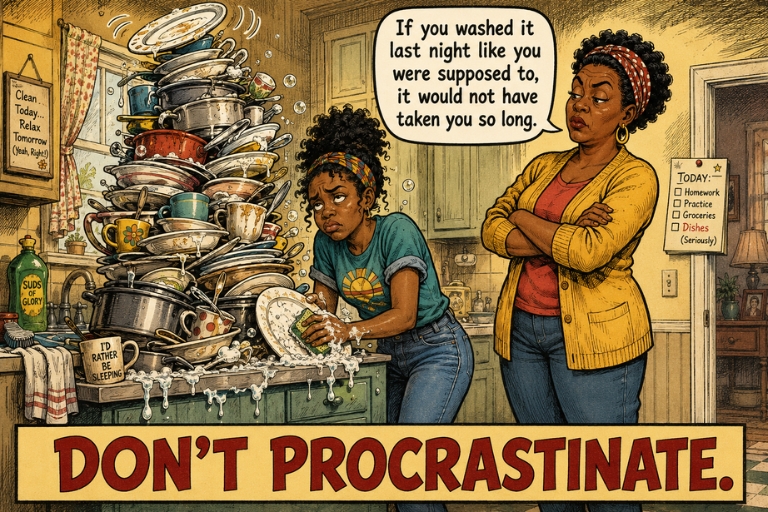
    Girl washing dishes

    Your homework is exactly the same. When you procrastinate, that assignment doesn’t sit quietly; it becomes “mental clutter.” It rots in the back of your brain, creating a lingering sense of anxiety that ruins your ability to actually enjoy your downtime. You can’t truly relax or hang out with friends when the “crusty dishes” of a math packet or a history essay are smelling up your mental space. Clean the plate now so you can enjoy your night with a clear conscience. High-performance living starts with realizing that “free time” is only rewarding when the work is actually behind you.

    2. The Illusion of Multitasking and the “Phone Tax”

    A lot of students think they can study while staying “connected.” They have a textbook open, but they’re also checking a group chat or scrolling through TikTok. Science is very clear: the human brain cannot actually multitask. Instead, it performs “task switching.”

    Every time you look at a notification, your brain has to neurologically recalibrate. This creates “attention residue,” where parts of your brain are still processing the last text while you’re trying to read a biology paragraph. This context switching reduces your efficiency by up to 40% and can temporarily lower your effective IQ by 10 points.

    To combat this, you must follow the External Device Rule: move your phone to another room entirely. Just having the phone in your line of sight creates a “sense of anxiety” about what you might be missing, which drains your cognitive battery.

    “The phone isn’t a small distraction. It’s a tax on every minute you think you’re studying. Putting it in another room isn’t dramatic; it’s just honest.”

    3. “Eat the Frog” – Why Your Toughest Task Must Come First

    Self-discipline isn’t about doing everything at once; it’s about doing the hardest thing first. This is the “Eat the Frog” method. If you have to eat a live frog, it’s best to do it first thing in the morning so the worst part of your day is behind you.

    Tackling your most aversive or difficult task right after school creates a massive psychological sense of momentum. Trust me on this: your future career success depends on this habit. In the professional world, high-value projects require the most energy. The people who “Eat the Frog” are the ones who get promoted because they handle the difficult, high-leverage tasks that others avoid.

    Typical Student “Frogs”:

    • A complex set of calculus differentiation problems.
    • Drafting the outline for a 10-page history research paper.
    • Memorizing a difficult list of chemical reactions or biological systems.

    4. Active Struggle vs. The “Illusion of Competence”

    Many students spend hours rereading notes and highlighting textbooks. This feels like work, but it’s actually “passive effort.” It creates an illusion of competence: because the material looks familiar while you’re looking at it, you mistake simple visual recognition for true memory recall.

    True learning requires “desirable difficulty.” Mental struggle is a biological requirement for neuroplasticity—the process of your neurons physically firing and wiring together to build stronger connections. If you want to master a topic, use Active Recall (pulling information from your brain without looking at notes) and the Feynman Technique (explaining a concept in simple language to ensure you actually understand the “why”). To maximize this, use Interleaving: mix different subjects or problem types in a single session. This forces your brain to temporarily “forget” and then “retrieve,” which strengthens memory pathways.

    Pro Tip: If you aren’t “mentally sweating,” you aren’t truly learning. That mental discomfort is the literal feeling of your brain physically rewiring itself into a higher-performance machine.

    5. Professionalism Through “Time Blocking” and Routines

    High-level strategists don’t rely on “feeling motivated”; they rely on systems. By using Time Blocking, you replace a messy to-do list with a concrete calendar. This eliminates decision fatigue—the phenomenon where your “cognitive battery” is drained simply by having to decide what to do next. When you pre-decide your schedule, you save all your energy for the actual learning.

    Every session should start with a 15-minute “Prime Period.” This isn’t fluff; it’s about lowering cortisol and eliminating friction. During this time, you must:

    1. Clear Visual Clutter: A clean desk signals to your brain that it’s time for focus.
    2. Hydrate: Fill your water bottle now to avoid mid-session excuses to leave your desk.
    3. Update the To-Do List: Identify your “Daily Highlight” so there is zero confusion about the goal.

    Sample High-Performance After-School Schedule:

    • 3:30 PM – 3:45 PM: Prime/Setup (Clean desk, fill water, set lighting to 4000K).
    • 3:45 PM – 5:00 PM: Deep Work / “Eat the Frog” (Focus on the hardest subject).
    • 5:00 PM – 5:10 PM: Short break (Movement, nature, or a snack—no screens).
    • 5:10 PM – 6:00 PM: Secondary tasks (Interleaving easier assignments or review).

    6. The Biological Infrastructure: Sleep as a Waste-Clearing System

    Think of sleep as a mandatory system requirement. While you sleep, your glymphatic system flushes out neurotoxic buildup. More importantly, your brain takes fragile data and moves it from the hippocampus (short-term) to the neocortex (long-term).

    Pulling an “all-nighter” essentially erases the previous day’s learning. Sleep deprivation causes a 40% discount in your brain’s ability to make new memories. If you don’t sleep, you are effectively operating at 60% capacity. You wouldn’t try to run a high-end software on a dying battery; don’t do it to your brain.

    7. Engineering Your Environment for Focus

    Your brain is highly sensitive to environmental cues. If you study in bed, your brain associates that space with sleep, ruining both your focus and your sleep quality. You need a dedicated “deep work” zone.

    Lighting Strategy:

    • Intense Focus: Use cool white light (4000K-5000K) to suppress melatonin and keep your mind sharp.
    • Winding Down: Switch to warm light (under 3000K) two hours before bed to protect your sleep cycle.
    • Positioning: Place your light source behind or to the side of your non-writing hand to eliminate shadows and glare.

    8. Conclusion: The Power of “Yet”

    Homework is not about the grade; it is the training ground for your life. Building self-discipline now is how you construct the professional “machine” that will power your future. When you hit a wall, don’t say you can’t do it. Use the power of the growth mindset: you can’t do it “YET.”

    Look yourself in the eye and decide what you want. Your future “CEO self” is counting on the habits you build today. Every “dish” you clean now makes your future success inevitable.

    Powerful Takeaway: Your learning ability decides your earning capacity. You aren’t just doing homework; you are mastering the machine that will define your career. Stop settling for 60% capacity—clean the dishes and eat the frog.

    Check out my complete solution for frustrated parents:

    https://lourensbreytenbach.com/reset

  • Stop Treating Your Brain Like a Junk Drawer:

    The PACER Framework

    You’ve been handed the keys to a biological supercar—the human brain—and most of you are out here trying to mow the lawn with it.

    Think about what happens when you walk into a hospital emergency room with a minor paper cut. The doctors don’t rush you into open-heart surgery while the person having a cardiac arrest waits in the lobby. They use triage: a system of sorting patients by urgency and type of injury so that the right resources go to the right places.

    Yet, when it comes to your studies, you likely treat your revision like a “junk drawer.” You take every definition, every complex diagram, and every random date in your textbook and try to shove them into your skull with the exact same amount of effort. This “Junk Drawer Effect” creates massive cognitive overhead, leading to burnout and the soul-crushing feeling that you are drowning in data.

    Here is the deal: your brain wasn’t built to store a junk drawer; it was built to build a universe. When you stop grinding and start categorising, you will find that learning is beautiful. It is not about the hours you log; it is about the system you use.

    If you are ready to stop the madness, let’s look at the framework. And if you want to master the full system, the growth starts here: www.lourensbreytenbach.com/shortcourse.

    The Case Study: Alex’s Flashcard Burnout

    I’ve sat across from a thousand Alexes. Alex is a dedicated Biology student, the kind of person you see in the library with a stack of 500 flashcards. He’s got everything on those cards: the definition of “cytoplasm,” the complex 10-step Krebs cycle, and niche Latin names for plants—all treated as identical “units” of information.

    Alex thinks he is winning because he is working hard, but he’s actually falling victim to cognitive habituation. Because he treats a simple word and a complex biological process as the same thing, his brain eventually stops paying attention. He isn’t actually encoding; he is simply performing studying. He’s flipping cards, but the info isn’t sticking. He’s exhausted, but his brain is just vibrating in place. He’s not learning; he’s just moving junk around in a drawer.

    The PACER Breakdown: Sort Your Brain

    To avoid the burnout trap, you need a mental sorting machine. Before you open a single book, you must categorise your information using the PACER framework.

    3.1 Procedural: The “How”

    This is for skills, methods, and step-by-step paths. Whether you are solving a complex Calculus problem or following the steps of the SQ3R/PQ4R reading methods, you are learning a process, not a fact.

    • Action Tool: Worked Examples. Instead of staring at a blank page in Maths and getting frustrated, study a “Worked Example.” This technique significantly reduces your cognitive load by showing you the step-by-step path to the solution. Once the “how” is clear, your brain can apply that logic to similar problems without the initial friction.

    3.2 Analogous: The “Like”

    Your brain is an association machine. It hates abstract, “boring” information that doesn’t connect to anything. If you can’t see what something is like, you won’t hold onto it.

    • Action Tool: The Feynman Technique (ELI5). Explain a concept in plain language as if you were teaching a 12-year-old. Use metaphors to anthropomorphise the abstract—for example, think of a computer function like a pencil sharpener: a dull pencil (input) goes in, a process happens inside, and a sharp pencil (output) is returned. If you can’t explain it simply, you don’t understand it yet.

    3.3 Conceptual: The “Why”

    This is the big-picture “web.” It’s about the relationships between ideas. This is where deep understanding lives.

    • Action Tool: Elaborative Interrogation & Mind Mapping. Never just accept a fact. Ask, “Why is this true?” and “How does this connect to what I already know?” Use a Mind Map to visually draw the hierarchy of these ideas. Seeing the “branches” helps your memory hold the weight of the concepts.

    3.4 Evidence: The “What”

    These are the hard facts, dates, and citations. This is the “raw data” that proves your point in an exam.

    • Action Tool: Active Recall. This is non-negotiable. Stop “reviewing” by reading your notes; that leads to visual recognition, where you mistake familiarity for true memory. You must force your brain to pull the information out through testing. If it feels difficult, good—that is the biological requirement for learning.

    3.5 Reference: The “Where”

    This is “low-value” information—niche formulas, specific dates, or directories. You need them for the task, but you don’t need to wire them into your long-term memory.

    • Action Tool: The Reference Dump. Stop wasting brain space. Use a “Parking Lot” method by putting these fine details into an external tool like Obsidian or a digital notebook. Let the technology hold the data so your brain can focus on the processing and the Maths.

    Why PACER Works: The Science of the “Mental Sweat”

    Learning isn’t a passive event; it is the physical rewiring of your brain, a process called neuroplasticity. When you use PACER, you are engaging in Desirable Difficulty. If you aren’t “mentally sweating,” you likely aren’t learning.

    By sorting your information, you create synaptic strengthening and eliminate “Attention Residue”—that mental fog caused by switching between unrelated tasks.

    The Neuro-Benefits of a Sorted Brain:

    • 40% Performance Boost: Research into interleaving (mixing different subjects and problem types) shows it can improve performance by up to 40% compared to “blocked” practice.
    • The Gap Effect: Taking periodic 10–30 second pauses during a session allows your hippocampus to rapidly replay and solidify the information you just processed.
    • Reduced Cognitive Overhead: Categorising info reduces the energy your brain wastes on deciding how to learn, leaving more fuel for actual understanding.

    Conclusion: The Field Test: The Highlighter Hack

    I want to set you a challenge. Stop “colouring pages orange.” Highlighting everything creates an “illusion of competence”—it makes the page look pretty, but it leaves your brain empty.

    The Hack: The Blurting Method

    1. Close your book and clear your desk.
    2. Blurt: Write down everything you can remember about a topic on a blank sheet of paper in one colour.
    3. Fill the Gaps: Open your notes and use a different colour highlighter to fill in exactly what you missed.

    This will feel uncomfortable. It will feel like “mental sweat.” But realise this: that discomfort is the literal feeling of neuroplasticity in action. It is the proof that you are growing.

    You are the pilot of the most powerful machine in the known universe. Stop being a passenger and start hacking the system.

    The system is waiting for you. Stop grinding and start growing at: www.lourensbreytenbach.com/shortcourse.

    Learning is beautiful. Let’s make it count.