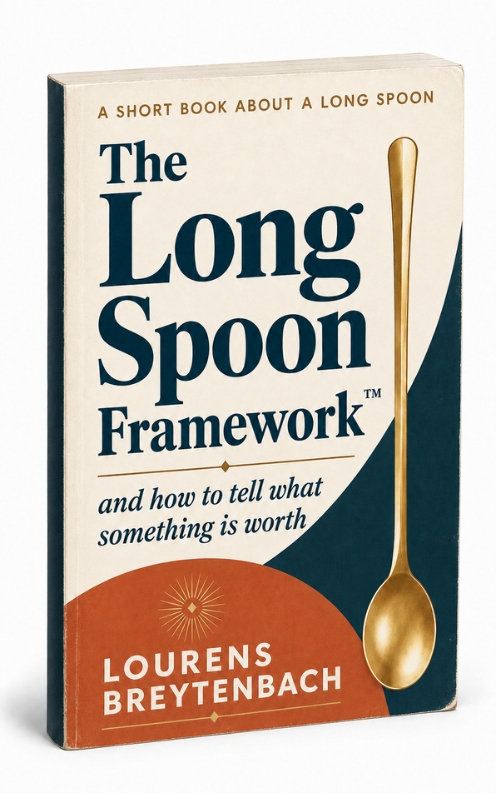
A short book about a long spon
by Lourens Breytenbach:
The “Long Spoon Framework” is a thinking tool and philosophy created by Lourens Breytenbach to evaluate the true worth and functionality of people, products, ideas, and decisions.
The Inspiration:
Rooted in an appreciation for an extended stainless steel teaspoon that efficiently reaches deep jars without burning knuckles, the framework uses this object as a metaphor for utility, simplicity, and practical impact.
The Three Spoons:
Every environment contains three types of entities:
The Short Spoon: Represents individuals or tools that cannot reach deep enough, resent demands, do the bare minimum with complaints, and blame their environment.
The Swiss Champ: Represents overly complicated, expensive, or feature-heavy items (like a complex multi-tool or an over-engineered course) that look impressive on paper but are rarely used or practical.
The Long Spoon: Represents effective entities that feature a single extended gift, are used daily, reduce difficulty, and leave a noticeable void when absent.
The Five Checks & The Master Question
The framework relies on a binary (yes/no) evaluation using five core checks, anchored by one superior master question:
Belong: Does it fit naturally into the existing environment without requiring a complete reorganization?
Stand Out: Does it possess a distinct, useful quality rather than mere decoration?
Reach: Can it solve problems or access areas that ordinary versions cannot, returning clean?
Protect: Does its involvement reduce mess, risk, difficulty, and harm?
Endure: Is it strong, reliable, and durable over time (such as across ten years)?
The Master Question (Would it be missed?): This outranks all other checks. Even if a thing passes all five checks, if its absence goes unnoticed, it lacks true long-spoon value.
Evaluation Rules
Scoring outcomes: 5 yeses indicate a true long spoon; 1 no indicates a fixable area where a specific handle should be lengthened; 2 or more noes mean it is not a long spoon yet.
Mandatory Rules:
The tester must run the evaluation on themselves first (the reader is case study one). The test can only be applied to someone if the evaluator is prepared to make them coffee first (establishing direct connection and cost).
Leave a Reply