A Guide to High-Performance Living
1. The “Rotten Dishes” Analogy
Imagine you just finished a big dinner. You have two choices: you can spend ten minutes rinsing the plates now, or you can leave them in the sink until tomorrow. If you leave them, the sauce dries into a cement-like crust, the smell starts to drift into the living room, and suddenly, the “relaxing” evening you planned feels a little gross. You’re sitting on the couch trying to watch a movie, but in the back of your mind, you know those dishes are rotting.
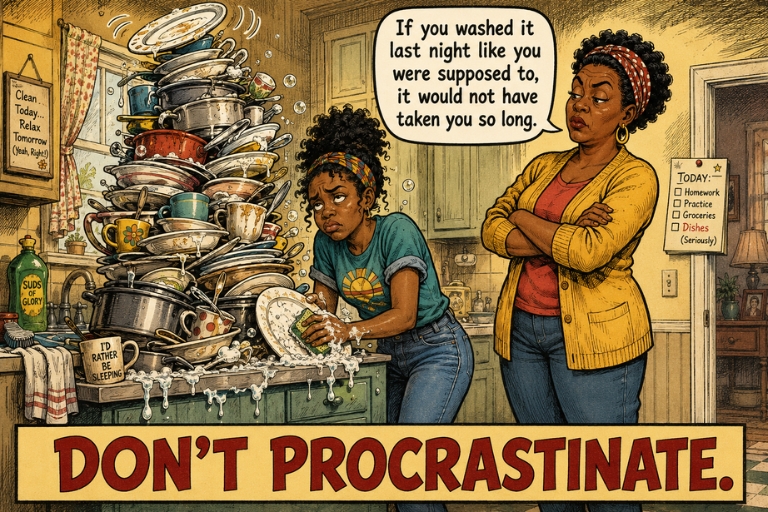
Your homework is exactly the same. When you procrastinate, that assignment doesn’t sit quietly; it becomes “mental clutter.” It rots in the back of your brain, creating a lingering sense of anxiety that ruins your ability to actually enjoy your downtime. You can’t truly relax or hang out with friends when the “crusty dishes” of a math packet or a history essay are smelling up your mental space. Clean the plate now so you can enjoy your night with a clear conscience. High-performance living starts with realizing that “free time” is only rewarding when the work is actually behind you.
2. The Illusion of Multitasking and the “Phone Tax”
A lot of students think they can study while staying “connected.” They have a textbook open, but they’re also checking a group chat or scrolling through TikTok. Science is very clear: the human brain cannot actually multitask. Instead, it performs “task switching.”
Every time you look at a notification, your brain has to neurologically recalibrate. This creates “attention residue,” where parts of your brain are still processing the last text while you’re trying to read a biology paragraph. This context switching reduces your efficiency by up to 40% and can temporarily lower your effective IQ by 10 points.
To combat this, you must follow the External Device Rule: move your phone to another room entirely. Just having the phone in your line of sight creates a “sense of anxiety” about what you might be missing, which drains your cognitive battery.
“The phone isn’t a small distraction. It’s a tax on every minute you think you’re studying. Putting it in another room isn’t dramatic; it’s just honest.”
3. “Eat the Frog” – Why Your Toughest Task Must Come First
Self-discipline isn’t about doing everything at once; it’s about doing the hardest thing first. This is the “Eat the Frog” method. If you have to eat a live frog, it’s best to do it first thing in the morning so the worst part of your day is behind you.
Tackling your most aversive or difficult task right after school creates a massive psychological sense of momentum. Trust me on this: your future career success depends on this habit. In the professional world, high-value projects require the most energy. The people who “Eat the Frog” are the ones who get promoted because they handle the difficult, high-leverage tasks that others avoid.
Typical Student “Frogs”:
- A complex set of calculus differentiation problems.
- Drafting the outline for a 10-page history research paper.
- Memorizing a difficult list of chemical reactions or biological systems.
4. Active Struggle vs. The “Illusion of Competence”
Many students spend hours rereading notes and highlighting textbooks. This feels like work, but it’s actually “passive effort.” It creates an illusion of competence: because the material looks familiar while you’re looking at it, you mistake simple visual recognition for true memory recall.
True learning requires “desirable difficulty.” Mental struggle is a biological requirement for neuroplasticity—the process of your neurons physically firing and wiring together to build stronger connections. If you want to master a topic, use Active Recall (pulling information from your brain without looking at notes) and the Feynman Technique (explaining a concept in simple language to ensure you actually understand the “why”). To maximize this, use Interleaving: mix different subjects or problem types in a single session. This forces your brain to temporarily “forget” and then “retrieve,” which strengthens memory pathways.
Pro Tip: If you aren’t “mentally sweating,” you aren’t truly learning. That mental discomfort is the literal feeling of your brain physically rewiring itself into a higher-performance machine.
5. Professionalism Through “Time Blocking” and Routines
High-level strategists don’t rely on “feeling motivated”; they rely on systems. By using Time Blocking, you replace a messy to-do list with a concrete calendar. This eliminates decision fatigue—the phenomenon where your “cognitive battery” is drained simply by having to decide what to do next. When you pre-decide your schedule, you save all your energy for the actual learning.
Every session should start with a 15-minute “Prime Period.” This isn’t fluff; it’s about lowering cortisol and eliminating friction. During this time, you must:
- Clear Visual Clutter: A clean desk signals to your brain that it’s time for focus.
- Hydrate: Fill your water bottle now to avoid mid-session excuses to leave your desk.
- Update the To-Do List: Identify your “Daily Highlight” so there is zero confusion about the goal.
Sample High-Performance After-School Schedule:
- 3:30 PM – 3:45 PM: Prime/Setup (Clean desk, fill water, set lighting to 4000K).
- 3:45 PM – 5:00 PM: Deep Work / “Eat the Frog” (Focus on the hardest subject).
- 5:00 PM – 5:10 PM: Short break (Movement, nature, or a snack—no screens).
- 5:10 PM – 6:00 PM: Secondary tasks (Interleaving easier assignments or review).
6. The Biological Infrastructure: Sleep as a Waste-Clearing System
Think of sleep as a mandatory system requirement. While you sleep, your glymphatic system flushes out neurotoxic buildup. More importantly, your brain takes fragile data and moves it from the hippocampus (short-term) to the neocortex (long-term).
Pulling an “all-nighter” essentially erases the previous day’s learning. Sleep deprivation causes a 40% discount in your brain’s ability to make new memories. If you don’t sleep, you are effectively operating at 60% capacity. You wouldn’t try to run a high-end software on a dying battery; don’t do it to your brain.
7. Engineering Your Environment for Focus
Your brain is highly sensitive to environmental cues. If you study in bed, your brain associates that space with sleep, ruining both your focus and your sleep quality. You need a dedicated “deep work” zone.
Lighting Strategy:
- Intense Focus: Use cool white light (4000K-5000K) to suppress melatonin and keep your mind sharp.
- Winding Down: Switch to warm light (under 3000K) two hours before bed to protect your sleep cycle.
- Positioning: Place your light source behind or to the side of your non-writing hand to eliminate shadows and glare.
8. Conclusion: The Power of “Yet”
Homework is not about the grade; it is the training ground for your life. Building self-discipline now is how you construct the professional “machine” that will power your future. When you hit a wall, don’t say you can’t do it. Use the power of the growth mindset: you can’t do it “YET.”
Look yourself in the eye and decide what you want. Your future “CEO self” is counting on the habits you build today. Every “dish” you clean now makes your future success inevitable.
Powerful Takeaway: Your learning ability decides your earning capacity. You aren’t just doing homework; you are mastering the machine that will define your career. Stop settling for 60% capacity—clean the dishes and eat the frog.
Leave a Reply